Ignazia Tempesta
I Know This Much Is TrueIgnazia Tempesta, formerly Violetta D’Annunzio, is Domenico Tempesta’s wife and the mother of Concettina Tempesta. Her story turns on the gap between the woman she is and the identities others impose on her: first a young woman who resists Domenico’s assumption that he can choose her, then a wife trapped by violence and suspicion, and finally a mother whose attachment to her surviving child exposes what Domenico cannot accept. The account is filtered through Domenico’s retrospective narration, so Ignazia’s actions and silences repeatedly stand against his efforts to explain or control them.
Identity and Arrival
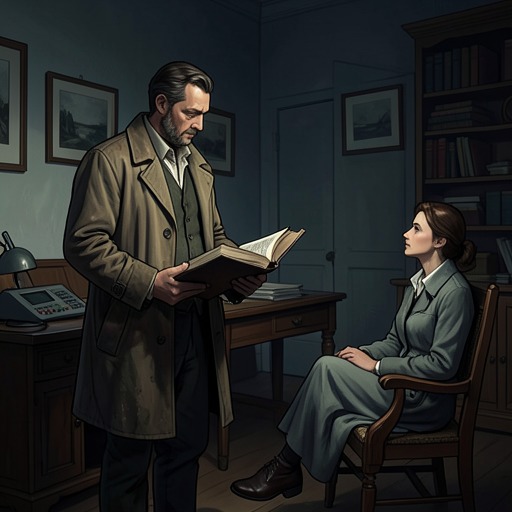
Before meeting Ignazia in person, Domenico is captivated by her portrait. He reads her appearance as a promise of beauty, then becomes more intensely drawn to the young woman who arrives at her brothers’ home later than expected. Her entrance is defiant, and her response to Domenico’s confidence punctures the marriage he has already imagined for her. He frames marriage as an arrangement he might consent to; she makes clear that his consent does not give him authority over her choice. Her refusal establishes a contrast that persists throughout their relationship: Domenico treats her as someone whose future can be decided for her, while Ignazia initially asserts a will that does not fit his plans.
Domenico describes his sudden desire through the image of Mount Etna’s heat, as if passion has overwhelmed his previously cool nature. That image reveals more about the intensity of his own conviction than about mutual understanding. He quickly decides that Ignazia must become his wife, even though her first response is rejection. The narrative’s romantic language is therefore shadowed by a question of power: Domenico experiences desire as a force that authorizes certainty, while Ignazia’s resistance shows that his certainty is not hers.
Violetta’s Past and the Family Secret
Ignazia’s hidden history is revealed through Prosperine Tucci. Before becoming Domenico’s wife, she was Violetta D’Annunzio, a woman who had left Pescara with Gallante Selvi. Prosperine recounts that Gallante’s treatment of Violetta turned the once-defiant young woman into someone fearful and withdrawn. Violetta had endured repeated abuse, humiliation, and sexual exploitation, including being made to pose for a photographer against her will. She also described a miscarriage and lasting effects from Gallante’s violence. Her story makes clear that the quiet, apprehensive woman Domenico sees is not simply the person Ignazia has always been; it is also the consequence of what she has survived.
Prosperine’s disclosure places Domenico before a choice. He understands that the woman in his home is connected to Violetta’s past, yet he refuses to bring the matter to the police. He fears scandal and damage to the Tempesta name, and he tries to persuade himself that Violetta is dead and that Ignazia is a separate person. This denial gives him temporary relief but cannot erase what he has learned. His shifting between the names Ignazia and Violetta registers the pressure of the truth without producing a willingness to act on it. The family’s secrecy protects its public standing while leaving the women to live with the consequences.
Marriage, Loss, and Motherhood
Ignazia gives birth to twins: one boy is stillborn, while the other child, a girl, survives. Domenico holds the dead infant as the living baby is delivered. Ignazia repeatedly calls the surviving child her daughter and kisses her, while Domenico remains focused on the dead son. He interprets Ignazia’s attachment as proof that she has no love for the boy he considers his, and he takes the twins’ births as confirmation of his suspicions about her past. These are Domenico’s conclusions, not an objective account of Ignazia’s paternity or feelings. The scene instead makes the difference between their grief unmistakable: she turns toward the child who lives, while he fixes on the child he has lost and on the doubts that divide them.
The surviving girl, Concettina Tempesta, has a cleft lip and red hair. Father Guglielmo urges Domenico to recognize her as a child deserving love and to accept her as his daughter. Domenico says that he cannot love her, though he points to the food, heat, and plumbing he provides for the household. Father Guglielmo identifies the limit of that provision: a materially supplied home can still withhold forgiveness. Ignazia’s care for Concettina is visible in contrast to Domenico’s insistence on accounting for what he believes he is owed. The child becomes a focus of both his suspicion and the tenderness he has difficulty allowing himself to share.
After a doctor warns that another birth could stop Ignazia’s heart, the couple never discusses the warning. Ignazia moves her clothes downstairs into Prosperine’s bedroom, and Domenico makes no move to claim the marital rights he believes are his. The arrangement registers a change in their domestic life without resolving its underlying fear or resentment. It gives Ignazia a separate sleeping place, but the silence around the medical danger also shows how little room their marriage makes for direct conversation about her safety.
Domestic Life and Uneasy Intimacy
After hearing Prosperine’s account of Violetta’s past, Domenico refuses to eat the food Ignazia prepares. Instead, he pays his former landlady to make his meals and to keep quiet. His choice turns the household secret into a daily practice: meals, wages, and silence are organized around a truth he cannot acknowledge openly. Ignazia is insulted by his refusal, but the account gives no indication that he tries to explain his behavior to her. His protection of the family name thus becomes another form of distance within the home.
There are also brief moments in which the household seems less divided. Domenico sings songs remembered from his mother to Concettina. Ignazia watches from the doorway, sometimes smiling, and she and the girl sing the songs together when Ignazia bathes her. The music gives Domenico short intervals in which he can imagine that the past has been put away and that Ignazia is simply his wife. Yet the comfort depends on his ability to suppress the identity Prosperine has disclosed. The songs connect the women through care and inheritance, but Domenico’s relief comes from treating that connection as evidence that his preferred version of the family might be true.
Death and Narrative Significance
On 17 August 1949, after Mass, Ignazia is in the kitchen while Concettina sits with Domenico, singing and drawing on the newspaper. Prosperine enters, and Domenico is already angry with her over complaints from the landlady about missed work and reduced wages. When he calls up the boardinghouse stairs for his wife using the name Violetta, the name exposes the identity he has repeatedly tried to contain. Ignazia appears with Concettina behind her. Her face is pale, and she holds the child close behind her as if to shield her. The scene makes the household’s fear legible through the way mother and daughter move together, rather than through any explanation Ignazia offers.
Ignazia’s body is later pulled from the bottom of Rosemark’s Pond, and Domenico says that he was present when it was recovered. The account establishes her death but does not establish its cause. Its placement after the renewed confrontation leaves the reader with the accumulated pressures of secrecy, domination, and unresolved suspicion, not with a definitive explanation of how she entered the water. Her ending is therefore also a limit on Domenico’s narrative authority: he can report what he witnessed, but his account cannot turn Ignazia’s silences into certainty.
Across her story, Ignazia’s most consequential acts are often small and relational: refusing Domenico’s assumption that she will marry him, protecting Concettina, seeking a separate sleeping space after a dangerous medical warning, and sharing her mother-in-law’s songs with her daughter. These moments do not undo the constraints around her, but they prevent her from being reduced to Domenico’s suspicions. Her life also exposes the cost of a household governed by male authority and family secrecy: survival is managed through concealment, provision is mistaken for care, and the person whose history is most in need of being heard dies without the narrative supplying a final account in her own voice.